


Is homosexuality a sin?

Yes. The Bible consistently teaches that sexual relations are ordained by God for marriage between one man and one woman and that sexual activity outside that covenant, including homosexual behavior, is sinful. This teaching is rooted not merely in a handful of isolated prohibitions but in creation, the moral law, the teaching of Christ, and the apostolic witness.
At the same time, Christianity does not teach that “homosexuals cannot enter heaven” while everyone else can. Scripture teaches something far more comprehensive and humbling: all people are sinners, all are unworthy of God's favor, and no one enters God's holy presence on the basis of his own moral condition.
“For all have sinned and fall short of the glory of God.”—Romans 3:23
None of us is naturally qualified for heaven. No one.
Christianity therefore does not approach this question from the standpoint of morally superior people passing judgment on a uniquely corrupt class of sinners. Scripture teaches that the corruption of sin reaches every one of us. We are all born fallen in Adam, with our minds, affections, desires, wills, and bodies affected by the fall. The particular forms that corruption takes differ from person to person, but no one possesses an unfallen nature from which to look down upon another.
This is why the Christian doctrine of homosexuality must never be separated from the Christian doctrine of original sin. Same-sex desire is not treated as though it were the only evidence of a disordered human nature. Pride, heterosexual lust, envy, greed, anger, covetousness, unbelief, self-righteousness, and countless other corrupt desires arise from the same fallen condition.
The Christian therefore does not say, “Your nature is corrupted, but mine is not.”
He says, “Apart from the grace of God, we are both ruined sinners in need of Christ.”
This does not mean that every sinful desire is identical in character or consequence, nor does it erase the distinctions Scripture makes between different sins. But it removes every basis for self-righteousness. The Christian's disagreement with homosexual practice is not grounded in personal superiority but in submission to the same Word of God that exposes and condemns his own sins.
Our problem is deeper than any one category of sin or suffering. We are born fallen in Adam and unable to make ourselves righteous before God. We do not merely need better behavior. We need reconciliation with God, forgiveness of sins, a new heart, and righteousness not our own.
The gospel is not that morally improved people are accepted by Christ. The gospel is that guilty and helpless sinners come to Christ empty-handed and are justified by grace alone, through faith alone, in Christ alone.
God's Created Order: Male and Female
The Bible's teaching concerning sexuality begins with creation:
“So God created man in his own image, in the image of God he created him; male and female he created them.”—Genesis 1:27
Jesus Himself reaffirmed this order when He said:
“Have you not read that he who created them from the beginning made them male and female?”—Matthew 19:4
Marriage is consequently defined by Scripture as the covenantal union of male and female:
“Therefore a man shall leave his father and his mother and hold fast to his wife, and they shall become one flesh.”—Genesis 2:24
This creational pattern precedes the Mosaic law, the nation of Israel, and the ceremonial regulations of the old covenant. Biblical sexual ethics therefore arise first from creation itself.
Someone may experience desires that do not correspond to that created order. Even if a person were born with such inclinations, however, their presence in a fallen world would not overturn God's created order any more than blindness overturns the reality of sight or infertility overturns the created reality of reproduction.
The existence of a condition does not by itself establish what ought to be.
Christian theology recognizes that the fall has affected the whole person, including the body, mind, affections, desires, and relationships. The presence of sinful dispositions or bodily disorders therefore does not make Scripture errant or invalidate God's created order. Rather, such realities remind us that the creation itself has been subjected to the consequences of the fall:
“The creation was subjected to futility” and “the whole creation has been groaning together in the pains of childbirth until now.”—Romans 8:20, 22
Creation awaits its final restoration. Our present experience, therefore, cannot become the ultimate standard by which God's created purposes are judged.
Scripture Explicitly Identifies Homosexual Practice as Sin
The Old Testament states plainly:
“You shall not lie with a male as with a woman; it is an abomination.”—Leviticus 18:22
And:
“If a man lies with a male as with a woman, both of them have committed an abomination.”—Leviticus 20:13
A common objection immediately follows: If Christians appeal to Leviticus concerning homosexual behavior, why do they not also enforce Israel's dietary laws, clothing regulations, and ceremonial ordinances?
The answer is that Scripture itself distinguishes between God's universal moral requirements and ceremonial regulations uniquely imposed upon Israel under the Mosaic covenant.
This distinction is especially clear in Leviticus 18–20.
God did not merely tell Israel, “Do not behave this way because you are Israelites.” He declared that the pagan nations already occupying Canaan were being judged because they practiced these very sins.
Leviticus 20 includes prohibitions against child sacrifice (v. 2), consulting mediums and necromancers (v. 6), adultery (v. 10), homosexual acts (v. 13), and bestiality (v. 15). God then explains:
“You shall not walk in the customs of the nation that I am driving out before you, for they did all these things, and therefore I detested them.”—Leviticus 20:23
Likewise, after listing numerous forms of sexual immorality in Leviticus 18, God says:
“Do not make yourselves unclean by any of these things, for by all these the nations I am driving out before you have become unclean.”—Leviticus 18:24
That is highly significant.
The Canaanites were not parties to the Mosaic covenant. They had never been commanded to keep Israel's Passover, dietary restrictions, priesthood, sacrificial system, or ceremonial calendar. Yet God held them accountable for idolatry, child sacrifice, incest, adultery, homosexual acts, and bestiality.
Why?
Because these sins violated God's moral order for mankind, not merely regulations peculiar to Israel.
Scripture nowhere records God judging Gentile nations because they ate shellfish, wore garments of mixed fabric, failed to observe Israel's feast days, or neglected Levitical sacrifices. Those ordinances belonged to Israel's ceremonial administration and anticipated their fulfillment in Christ.
But Scripture repeatedly judges Gentile nations for murder, idolatry, oppression, adultery, sexual immorality, and other moral evils.
The distinction is therefore not arbitrary. Scripture itself reveals it through the things for which God holds the nations accountable.
Sodom Was Judged Before the Mosaic Law
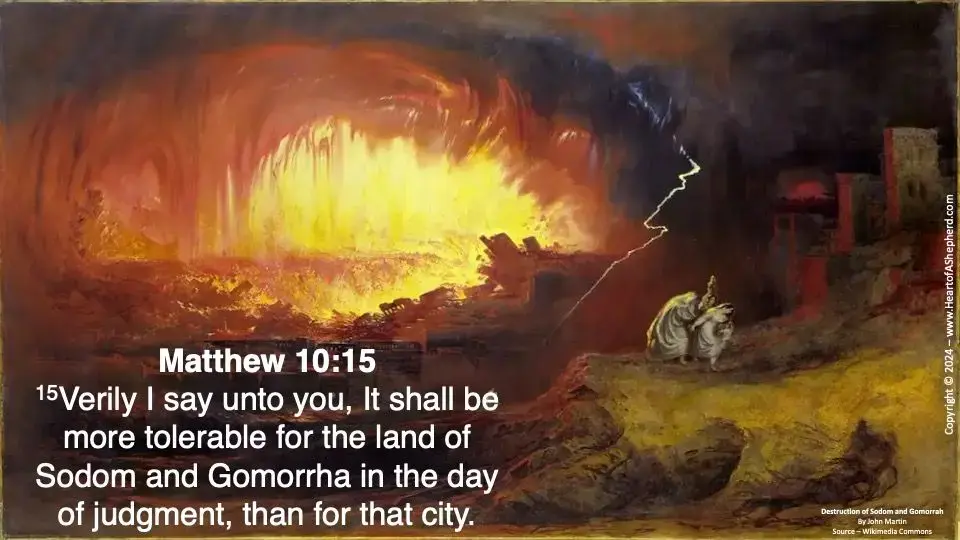
Sodom and Gomorrah provide another important example because their destruction occurred centuries before Moses.
Jude writes:
“Sodom and Gomorrah and the surrounding cities, which likewise indulged in sexual immorality and pursued unnatural desire, serve as an example by undergoing a punishment of eternal fire.”—Jude 7
Whatever additional sins characterized Sodom, Scripture certainly mentions pride, prosperity without compassion, violence, and wickedness. Jude nevertheless explicitly identifies sexual immorality and unnatural desire among the sins for which those cities became an example of divine judgment.
The moral principle, therefore, cannot be dismissed as a uniquely Mosaic ceremonial regulation.
Romans 1 Makes the New Testament Teaching Explicitly
The clearest New Testament answer comes from Romans 1.
Paul is describing Gentile humanity, specifically those who did not possess the Mosaic law. Yet he says God's wrath is revealed against their ungodliness because they suppress truths about God evident in creation.
Their rejection of the Creator results in disorder both in worship and in human desires:
“For this reason God gave them up to dishonorable passions. For their women exchanged natural relations for those that are contrary to nature; and the men likewise gave up natural relations with women and were consumed with passion for one another.”—Romans 1:26–27
Paul's argument is crucial because it joins together creation, natural order, human accountability, and homosexual behavior.
He is not arguing that Gentiles violated an obscure Israelite ceremonial regulation. He is arguing that mankind has rejected the Creator and consequently overturned the order evident in creation itself.
Romans 1 therefore provides an explicit New Testament confirmation of the moral principles reflected in Leviticus 18–20.
Paul later explains why Gentiles remain morally accountable even without possession of the written Mosaic law:
“They show that the work of the law is written on their hearts, while their conscience also bears witness.”—Romans 2:15
God's moral government extends over all humanity.
The New Testament Continues the Same Sexual Ethic
Nor is Romans 1 an isolated text.
Paul writes:
“Do you not know that the unrighteous will not inherit the kingdom of God? Do not be deceived: neither the sexually immoral, nor idolaters, nor adulterers, nor men who practice homosexuality, nor thieves, nor the greedy, nor drunkards, nor revilers, nor swindlers will inherit the kingdom of God.”—1 Corinthians 6:9–10
Notice carefully that homosexuality is not singled out as though it were the one uniquely damning sin. It appears within a much broader catalogue, including heterosexual immorality, adultery, idolatry, theft, greed, drunkenness, and reviling.
Then comes one of the most important sentences in the entire discussion:
“And such were some of you. But you were washed, you were sanctified, you were justified in the name of the Lord Jesus Christ and by the Spirit of our God.”—1 Corinthians 6:11
That is the gospel.
Christ does not merely condemn sinners. He washes them.
He does not receive people because they have never experienced corrupt desires. He receives sinners who come to Him in repentance and faith.
Temptation Is Not the Same Thing as Approval of Sin
It is also important to distinguish between experiencing temptation and approving or practicing sin.
Christians continue to battle remaining corruption. A believer may experience profound temptations in many areas: sexual desire, anger, envy, pride, greed, fear, covetousness, or countless others.
The decisive question is not, “Have I ever experienced a sinful desire?”
If that were the standard, no Christian could stand.
The question is whether we acknowledge God's Word as true, trust Christ for salvation, repent of our sins, and seek by the power of the Holy Spirit to walk in obedience to Him.
The Christian does not say, “Whatever desires I experience must therefore be morally good.”
He says with Scripture:
“Those who belong to Christ Jesus have crucified the flesh with its passions and desires.”—Galatians 5:24
Repentance does not mean that every temptation instantly disappears. Nor does the persistence of temptation necessarily prove the absence of grace. It means that we cease defending our sin against God and instead bring our desires, conduct, and identity beneath the lordship of Christ.
The Gospel Is for Sinners
This brings us to the most important point.
Christianity does not teach:
“Straight people go to heaven and homosexual people do not.”
Christianity teaches:
No sinner deserves heaven.
The heterosexual adulterer cannot save himself.
The homosexual sinner cannot save himself.
The greedy cannot save themselves.
The proud cannot save themselves.
The self-righteous cannot save themselves.
The religious hypocrite cannot save himself.
None of us can.
Our hope is entirely outside ourselves:
“Christ Jesus came into the world to save sinners.”—1 Timothy 1:15
The gospel is not that naturally whole, sexually untempted, and morally respectable people qualify themselves for heaven. The gospel is that Jesus Christ lived the righteous life sinners have failed to live, bore the judgment deserved by His people, rose from the dead, and freely receives everyone who comes to Him in repentance and faith.
No sinner comes possessing moral credentials.
We come empty-handed.
And Christ is a sufficient Savior.
Truth Without Cruelty, Compassion Without Compromise
Christians should therefore speak about homosexuality with both truth and humility.
People who experience homosexual inclinations should never be treated as though they belong to a uniquely contemptible category of humanity. Christians have no grounds for self-righteous superiority. We are not people who qualified ourselves for God's favor looking down upon people who failed to qualify.
We are sinners who have received mercy.
A Christian speaking to someone who experiences same-sex attraction should therefore be able to say, with complete sincerity, "I am not standing above you. My own heart is corrupted by sin, and I need the same Savior I am commending to you.”
At the same time, genuine compassion cannot require us to call good what God calls sin. Love does not require altering God's created order or silencing the warnings of Scripture. Christ joins grace and truth together, and Christians must seek to do the same.
People with homosexual inclinations should be treated by Christians with truth, compassion, patience, and humility. They are no more undeserving of God's favor than we are, and we are no more deserving of it than they are.
Therefore the biblical answer is clear:
Yes, Scripture teaches that homosexual behavior is sinful, just as it teaches that adultery, fornication, greed, idolatry, drunkenness, theft, pride, hatred, and countless other expressions of our fallen nature are sinful. But Scripture's message does not end with condemnation. Jesus Christ receives repentant sinners, forgives them, justifies them, cleanses them, and begins conforming them to His image.
No one is saved because he is naturally whole, morally superior, or free from corruption.
Sinners are saved only because Jesus Christ came into the world to save sinners.
The defining question for any sinner is therefore not
“Am I naturally free from corruption?”
None of us is.
The question is
“Am I trusting in Jesus Christ alone for mercy, and am I willing to follow Him as Lord?”
There is no class of repentant sinner whom Christ is unwilling to receive.
“Whoever comes to me I will never cast out.”—John 6:37


Comments